Looking back, I have made both less and more progress than I anticipated. Almost all of the calculus review remains to do, and it’s clear that part of the project is going to be a long haul. On the other hand, my work on calculus prerequisites and logic has been fruitful, and quite a bit of geometry knowledge has returned to me without deliberate review. More importantly, my ability to think mathematically and my joy in doing so have both resurged far beyond my expectations. Overall, I think the project has been a success so far.
I plan to keep going as I have been, for the most part. I’ve decided to begin taking Sundays off from blogging, however, and relaxing my study goals for that day. I think a weekly rest will help me sustain the project long term.
So see you on Monday, faithful readers. Thank you for all your support during these first 100 days.
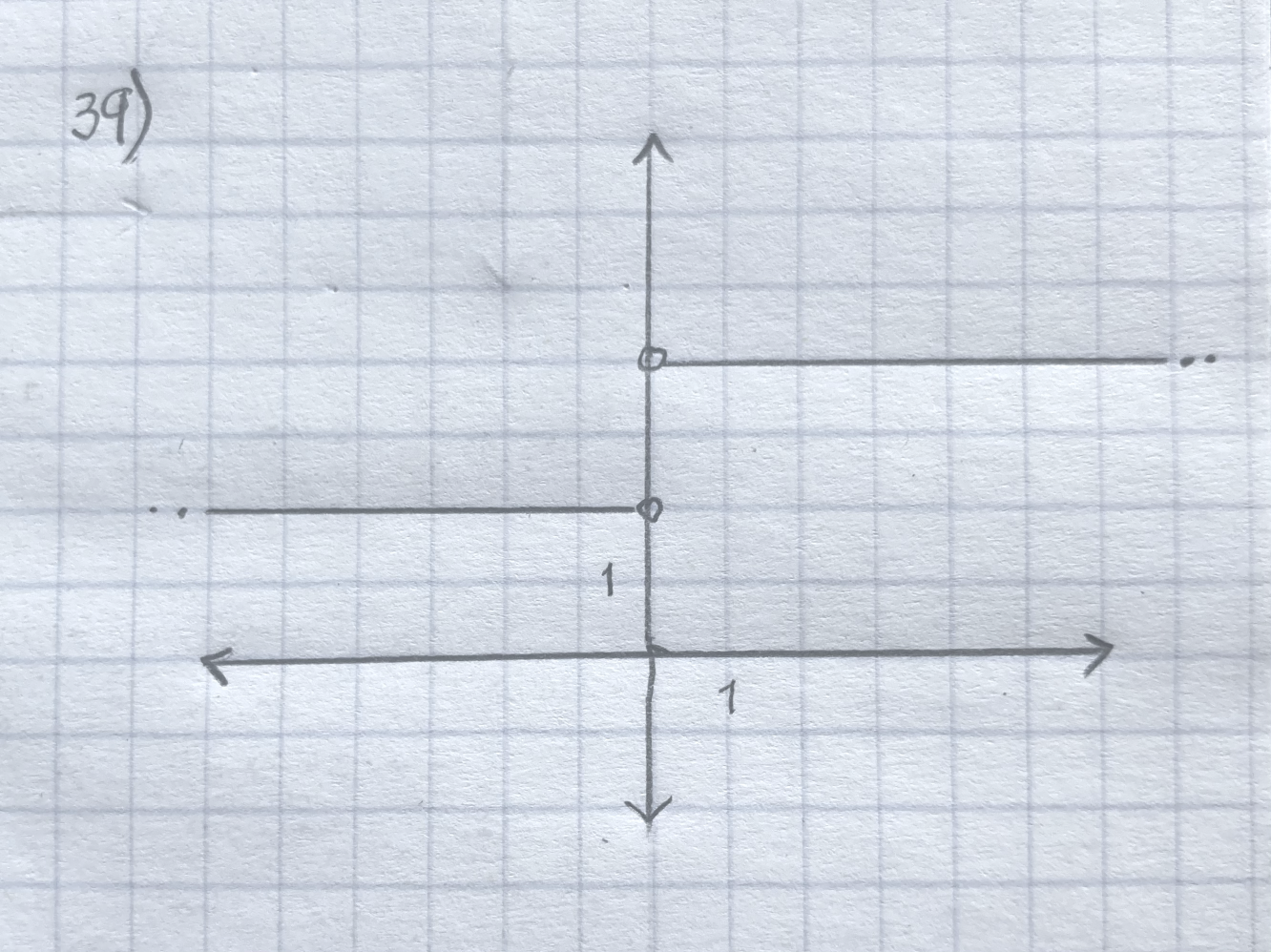
Today I spent two hours on calculus exercises. Among other things, this involved drawing thirteen graphs.1 That part was a bit tiresome, but I did learn from it. My favorite was the graph of $$f(x) = \frac{3x+|x|}{x}\text{,}$$ which didn’t look at all the way I had imagined before thinking it through. Click here to see the graph.
Today I was able to spend more than an hour on calculus exercises. (Yay!) Now I am pondering the following:
The volume of a sphere of radius $r$ is given by $V=\frac{4}{3}\pi r^3$. The surface area of the same sphere is given by $A=4\pi r^2$, the derivative of the formula for the volume. This makes sense, as a small change in volume involves adding a thin layer to the surface of the sphere. In the limit, that layer will be identical to the sphere’s surface.
On the other hand, the surface area of a cube of side length $x$ is given by $A=6x^2$. This is not the derivative of $V=x^3$, the formula for the cube’s volume. Why?1
I was very busy today, at least for me. I didn’t have time for any study until evening, when I sat down to look at a copy of Gauss’s Fünfstelliges logarithmisches Tafelwerk that I just received.
No, not that Gauss. This Gauss is Friedrich Gustav Gauss (1829-1915), my great-great-great-grandfather. He was a surveyor for the Prussian government (at that time a very mathematical profession) and later an administrator in the same department. He also published several books of logarithmic tables, one of which was republished in the 1970s in the compact edition shown below.
Fünfstelliges logarithmisches Tafelwerk (Book of Five-digit Logarithmic Tables)
I tried for quite a while to make sense of the tables in this book. Some of them are dedicated the logarithms of integers and others to the logarithms of trigonometric functions evaluated for particular angles, but that’s about as much as I could understand. The actual values tended not to be what I thought they should, so I was clearly missing a lot. The fact that the book was in German was not that great a hindrance, I don’t think. There was not much explanatory material. The publishers clearly expected the book’s users to be familiar with tables of this kind.
I didn’t feel very well today, either. I read some of Infinite Powers and worked on my logarithm problem. I am not ready to present a proof, but I have satisfied myself that if $a$ and $b$ are natural numbers greater than $1$, then they must be powers of the same base in order for $\log_a b$ to be rational. I’m not sure how to begin thinking about other types of numbers, and it’s possible I will lay that question aside for now.1
I am still not making much progress on my calculus review. It’s an important part of this project, because I hope it will prepare me to earn some money tutoring. The truth is, though, that a lot of the time I am just not hale of mind. I’m doing my best.
I had a lot of anxiety today, which didn’t lend itself to study. I did a little work on the logarithm question I’ve been talking about, but nothing else.
(For those wondering, the question is what the relationship between $a$ and $b$ must be in order for $\log_a b$ to be rational. It arose from a exercise in Analysis with an Introduction to Proof that asked me to prove that $\log_2 7$ is irrational.)
A few days ago, I watched a video with the engaging title The Mosaic Problem – How and Why to Do Math for Fun by a YouTuber called Jack Hanke. His suggestion was to have a motivating problem (which he called a back burner problem) in mind when studying a branch of math. Then, whenever a new concept comes up, you can think about how it might apply to your problem. I haven’t really been struggling to do math for fun (at least when I’m able to do math at all), and my own approach is more to look for questions to ask about whatever I’m learning than to try to apply it to questions I already have. I’m intrigued by his idea, though, and may want to test it out at some point.
Today I worked on a variety of things. I did some exercises in my calc book, worked on my question about logarithms, read about irrational numbers, and thought a bit about the Triangle of Doom. It was all more or less fun, though the calc exercises were a little repetitive. I may have to rethink my practice of doing all the exercises in every section.
I felt better today. I worked for about an hour on exercises in Analysis with an Introduction to Proof and for another half hour on a question about logarithms that occurred to me while doing one of the exercises. I also spent quite a bit of time on a puzzle I call the Triangle of Doom. (It is more widely known as the Hardest Easy Geometry Problem.) I first encountered and worked on it in 2006, but before today I hadn’t looked at it in a long time.
The puzzle is to find the the value of $x$ in the figure below without using trigonometry.1 (Image source)
I didn’t solve the Triangle of Doom today, but I had some ideas.
The measures of many of the angles are easy to find using familiar geometry: vertical angles, supplementary angles, and the fact that the angles of a triangle sum to 180 degrees.
Adding the fact that if two angles of a triangle are equal, then the sides that subtend them are also equal, reveals that the whole triangle is isosceles and that it also contains two smaller isosceles triangles, as highlighted below in blue and green. I suspect these isosceles triangles will have some role in the solution.
Something I’m not sure the significance of is that there also appear to be two similar triangles in the figure, as highlighted below in yellow. I cannot yet prove that these are similar—that would be to solve the puzzle—but tests using the Desmos geometry tool left me nearly sure. (You can check out my interactive drawing here for however long the link lasts.) The relationship might be a coincidence, though, since it is not preserved when three isosceles triangles overlap in the same way but with different angle measures.
More low-level depression and concentration problems today, but I did do a bit of watching and reading. I also finished writing up the proof below, which I know you’ve all be waiting for. As I explained yesterday, I’ve tried to make it a bit more readable than other proofs I’ve posted recently.
Proposition: If $\triangle ABC$ is an equilateral triangle inscribed in a circle and $D$ is a point on the circle between $A$ and $C$, then $AD+CD=BD$.
Place a point $E$ on $\overline{BD}$ so that the distance from $D$ to $E$ is the same as the distance from $D$ to $C$, as shown below.
Draw the segment $\overline {CE}$.
Since the original triangle, $\triangle ABC$, is equilateral, its three angles must be equal by the proposition from the post Easy Lemmas.
The sum of the measures of the three angles of a triangle is $\pi$ radians. Thus, when the three angles are equal, each one must measure $\frac{\pi}{3}$. It follows that the angles of $\triangle ABC$ have this measure: $\angle BAC=\angle ABC=\angle ACB=\frac{\pi}{3}$.
Because they are both subtended by arc $BC$, by the second proposition from the post Angles and Arcs, $\angle BAC$, the leftmost of the angles of the original equilateral triangle, is equal to $\angle BDC$, the rightmost of the angles with their verticies at $D$.
Similarly, because they are both subtended by arc $AB$, $\angle ACB$, the rightmost of the angles of the original equilateral triangle, is equal to $\angle ADB$, the leftmost of the angles with their verticies at $D$.
It follows that the two angles with their verticies at $D$, $\angle BDC$ and $\angle ADB$, both measure $\frac{\pi}{3}$.
Consider the newly formed triangle $\triangle CDE$. Two of its sides, $\overline{CD}$ and $\overline{DE}$, are equal by construction (i.e. because of the way point $E$ was chosen). Thus, the two angles subtended by those sides, $\angle CED$ and $\angle DCE$, are equal to one another by the lemma from the post Revenge of the Squares, Part 1.
Furthermore, since $\angle CDE$, the other angle of $\triangle CDE$, is one of the angles that measures $\frac{\pi}{3}$, it follows that $\angle CED$ and $\angle DCE$ together must measure $\pi-\frac{\pi}{3}=\frac{2\pi}{3}$ and that each one individually must measure $\frac{\pi}{3}$.
Hence the three angles of $\triangle CDE$ are all equal, from which it follows, by the proposition in the post Easy Lemmas, that $\triangle CDE$ is equilateral.
Now consider $\angle BEC$, the angle supplementary to $\angle CED$, the uppermost of the angles of $\triangle CDE$. Since the angles of $\triangle CDE$ all measure $\frac{\pi}{3}$, the supplementary angle $\angle BEC$, must measure $\frac{2\pi}{3}$.
Note that, since each one measures $\frac{\pi}{3}$, the sum of $\angle ADB$ and $\angle BDC$, the two equal angles with their verticies at $D$, is also $\frac{2\pi}{3}$. Thus, the measure of $\angle ADC$, the large angle they form, is also $\frac{2\pi}{3}$.
Yet that means that the two triangles highlighted above in yellow, $\triangle BCE$ and $\triangle ACD$, are congruent by the side-side-angle property, which applies when the angle in question is greater than or equal to $\frac{\pi}{2}$. The triangles’ large angles, $\angle BEC$ and $\angle ACD$, are equal, as just shown, and measure $\frac{2\pi}{3}$; their long sides, $\overline {BC}$ and $\overline {AC}$, are equal, since both are sides of the original equilateral triangle $\triangle ABC$; and another pair of their sides, $\overline {CE}$ and $\overline {CD}$, are equal because both are sides of the new, smaller equilateral triangle $\triangle CDE$.
It follows that the remaining sides, $\overline {BE}$ and $\overline{AD}$, are equal, as well. Hence $BE=AD$.
As above, $DE=CD$ by construction.
Thus $AD+CD=BE+DE$. Yet $\overline {BE}$ and $\overline {DE}$ together make up the larger segment $\overline {BD}$. Therefore $AD+CD=BD$ and the theorem of is proven.
With the addition of SSA for right and obtuse angles, I think I might have a complete set of triangle congruence properties to prove.1
I could almost have done this proof without assigning measures to the angles. Equality between $\angle BEC$ and $\angle ADC$ could be established using the property of triangles illustrated below, and I think I could have shown that they are obtuse as well. Without angle measures, though, I couldn’t think of a way to show that, with two sides of $\triangle CDE$ equal by construction, not only must the angles they subtended be equal to one another, but both must be equal to the third angle.
Let me know what you thought of this verbose-mode proof. I found it a little difficult to write without an audience clearly in mind.